Ofsted supported accommodation inspections for 16 and 17 year olds
How Ofsted inspects supported accommodation for 16 and 17 year olds: notice, frequency, the three outcomes, which premises it visits and the records it reads.
Quick answer
Ofsted inspects registered supported accommodation for looked-after 16 and 17 year olds and care leavers under the social care common inspection framework. It phones ahead and arrives two working days later, visits a sample of premises, reads children's records, supervision notes and staff files, and gives one of three outcomes. It comes back at least every three years, sooner after a weak outcome.
The short version
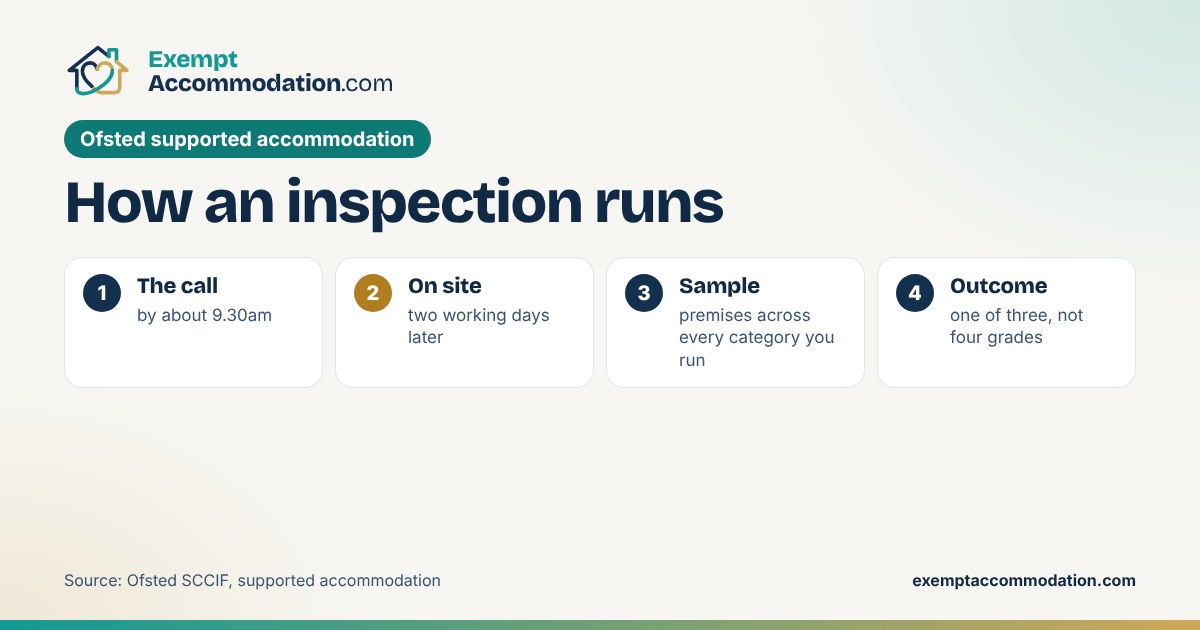
- Inspections are announced by phone, usually by 9.30am, with inspectors on site two working days later.
- Every provider is inspected at least once in a three-year window. A weaker outcome brings the next visit forward, to around 18 months or around six months.
- Supported accommodation gets one of three outcomes, not the four-point grades used for children's homes.
- Inspectors visit a sample of premises across every accommodation category you run, so your smallest or newest address can be the one they see.
- They read children's records, supervision notes from the last three months, health and safety checks, and staff training and recruitment records.
In this guide
If you provide supported accommodation for looked-after 16 and 17 year olds or care leavers, you must be registered with Ofsted, and Ofsted will inspect you. This guide covers what happens when Ofsted inspects you. For who needs registering, who pays and how licensing treats young people's schemes, see supported accommodation for care leavers and 16 to 17 year olds.
How the inspection starts
Ofsted phones the provider, usually by 9.30am, and inspectors arrive on site two working days later. That is enough time to arrange access to premises and tell young people and hosts what is happening. It is not enough time to write missing records, and inspectors are looking at what has been happening over months.
Have one person ready to take the call who knows where everything is: the list of premises, the children currently placed, staff rotas and the records below.
How often Ofsted comes back
Every registered provider is inspected at least once in a three-year window, on a rolling cycle. The outcome sets the timing of the next visit:
| Outcome | Next inspection, roughly |
|---|---|
| Strongest outcome | Around 3 years |
| Middle outcome | Around 18 months |
| Weakest outcome | Around 6 months |
The three outcomes
Children's homes get the familiar four grades, from outstanding to inadequate. Supported accommodation does not. Ofsted gives one of three outcome statements instead:
- Consistently strong service delivery leads to typically positive experiences and progress for children.
- Inconsistent service delivery affects some children's experiences and may limit their progress.
- Serious or widespread weaknesses lead to significant concerns about children's experiences and progress.
The middle outcome is the one to watch. It describes a service that works for most young people but not all, which is where most quiet record-keeping gaps end up.
What inspectors judge
Inspectors look at three things:
- The overall experiences and progress of children.
- How well children are helped and protected.
- How effective leaders and managers are.
The third one is where paperwork matters most. Managers are judged on whether they know what is happening in their own service, and the records are how they show it.
Which premises they visit
Inspectors visit a sample of your premises, and always a spread across every accommodation category you run. The sample size depends on how many premises you have:
| Premises you run | Inspectors are likely to visit |
|---|---|
| 1 or 2 | All of them |
| Up to 5 | At least 2 |
| 6 to 20 | A quarter to a half, for example at least 3 of 6 and at least 5 of 20 |
| 21 or more | Usually 10 to 25 percent, for example at least 6 of 21 |
| 100 or more | Normally no more than 12 |
The records they read
Ofsted lists the records inspectors sample. Get these in order before anything else:
- Children's records, such as care plans, pathway plans and review minutes.
- Documents that show each child's progress.
- Supervision notes from the last three months.
- Minutes of professional meetings.
- Health and safety checks.
- Staff training and recruitment records.
- For supported lodgings, host assessments and matching or host review records.
Inspectors read these to see whether the records match each other. A pathway plan that says a young person is in college, next to daily notes that never mention college, tells them more than either document alone.
Where providers come unstuck
From the records list, these are the gaps that tend to show up together:
- Plans that are not reviewed. A care or pathway plan written at move-in and not updated since, while the young person's situation has changed.
- Supervision on paper only. Notes that exist for every month but repeat the same actions, with nothing followed up.
- Hosts left out. Supported lodgings hosts without current assessments, reviews or supervision, because they are not staff.
- Premises checks without the fix. A safety check that found a problem, with no record of it being put right.
- New starters. Recruitment files for the most recent hires missing references or DBS checks, because they were rushed in to cover shifts.
How this fits with licensing and the national standards
Most young people's providers also run adult services, or move young people on into them at 18. The government's April 2026 response says Ofsted-regulated schemes for young people up to 25 will be exempt from supported housing licensing where at least one bed is Ofsted regulated. Schemes with no Ofsted-regulated beds are expected to need a licence and to meet the National Supported Housing Standards.
If you run both, keep one set of record-keeping habits across both services. The evidence Ofsted reads for a 17 year old and the evidence a council will ask for at licensing for a 19 year old come from the same plans, reviews and support notes. See the licensing and national standards guide for where that regime has got to.
Your next step
Pick three children's files and three months of supervision notes today and check them against the list in this guide.
Questions people ask
How much notice does Ofsted give before a supported accommodation inspection?
Ofsted phones the provider, usually by 9.30am, and inspectors arrive on site two working days later. Use those two days to get access arranged and records ready, not to fix gaps. Inspectors can tell when records were written in a hurry.
How often does Ofsted inspect supported accommodation?
At least once in every three-year window. When the outcome is the strongest of the three, the next inspection is usually around three years later. The middle outcome brings it forward to about 18 months, and the weakest to about six months.
What are the three Ofsted outcomes for supported accommodation?
The first says consistently strong service delivery gives children typically positive experiences and progress. The second says inconsistent quality affects some children's experiences and may limit their progress. The third says serious or widespread weaknesses raise significant concerns.
How many of our properties will Ofsted visit?
It depends on how many premises you run. Providers with one or two premises are likely to have all of them visited. With up to five, at least two. With six to 20, between a quarter and a half. Larger providers usually see 10 to 25 percent, normally capped at 12 premises, and always a spread across every accommodation category.
Does Ofsted inspect the landlord or the provider?
The provider. Registration and inspection sit with the organisation providing the supported accommodation, not the owner of the building. A landlord leasing to a young people's provider should still check the registration covers its address and keep the property to the accommodation standard.
Sources
Primary legislation and official guidance come first. Where we rely on commentary, we say so.
- 1Social care common inspection framework (SCCIF): supported accommodation for looked after children and care leavers aged 16 and 17 Ofsted
- 2The Supported Accommodation (England) Regulations 2023 legislation.gov.uk
- 3Inspections of supported accommodation: information for supported lodgings hosts Ofsted social care blog
- 4Proposals for inspecting supported accommodation Ofsted
Regulation alerts
Get alerts when this changes
One short email when licensing, Housing Benefit or national standards change, with what it means for your service. About once a month.
Support Audit
Want a dry run before Ofsted calls?
Support Audit reads a sample of your young people's files, supervision notes and premises checks the way an inspector would, and tells you what would show up.
Read next
All guidesSupported accommodation for care leavers and 16 to 17 year olds
Supported accommodation for 16-17 year olds: Ofsted registration, who pays rent at each age, Staying Put, the shared rate exemption and youth scheme licensing.
Updated Nov 2026
How to prepare for a supported housing audit
How to prepare for a supported housing audit: map schemes, test files against the four-week needs assessment timescale, check property, rent and governance.
Updated Nov 2026
Property standards and safety in supported housing
Supported housing property standards: HHSRS, HMO licensing, fire safety, gas and electrical checks, smoke and CO alarms, Awaab's Law and Decent Homes.
Updated Oct 2026